
August 5, 2026 · Health AI governance, decision authority and patient safety
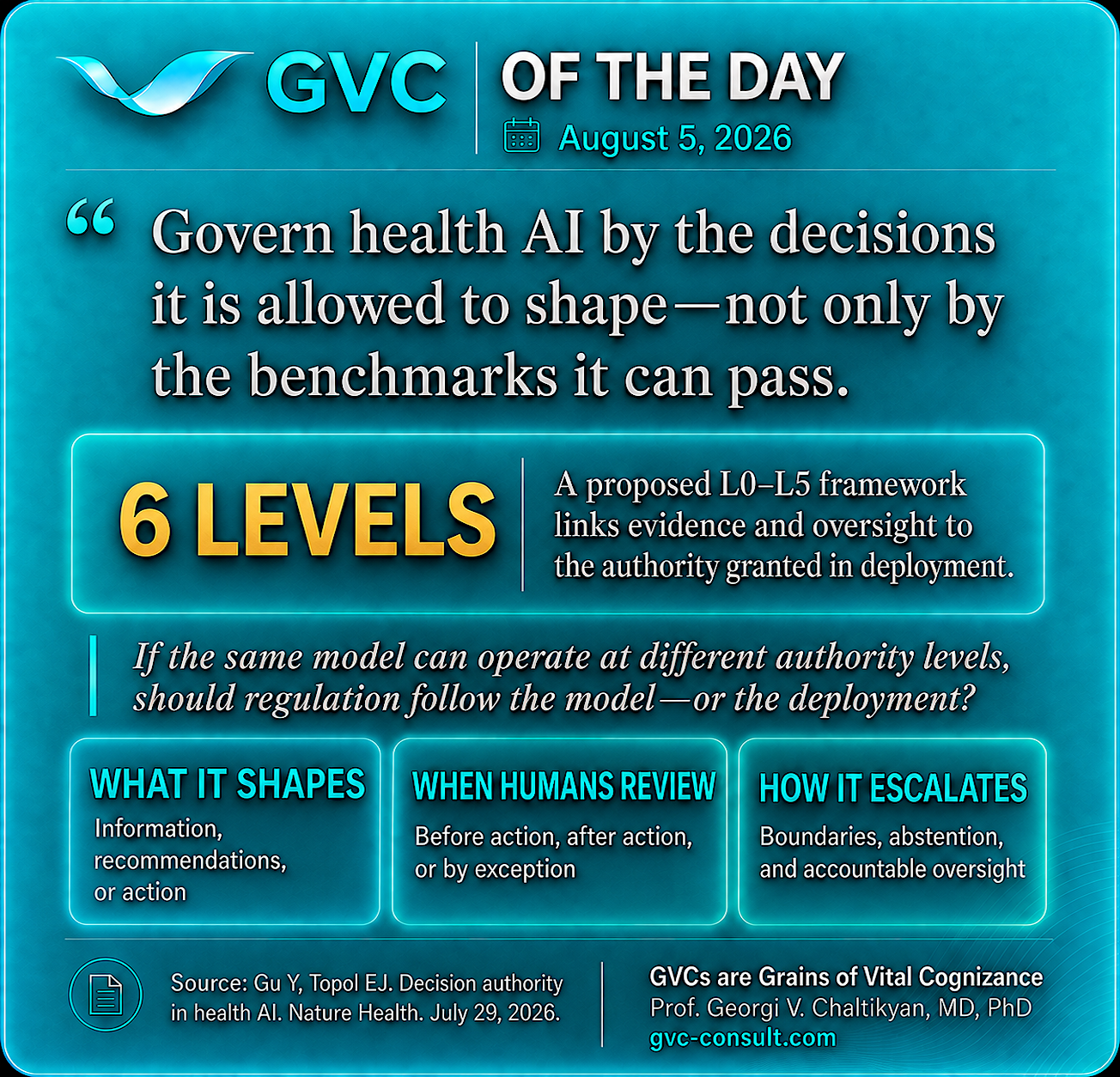
Govern Health AI by the Decisions It Can Shape—not Only by the Benchmarks It Can Pass
In a Nature Health Comment, Yu Gu and Eric J. Topol propose a six-level L0–L5 framework for classifying the “decision authority” granted to AI for Health. Their premise is consequential: AI may influence a person’s health trajectory before a clinician enters the loop.
Even a system described as informational may shape how people interpret symptoms, judge urgency or decide whether to seek care. The framework therefore asks what the AI is permitted to shape—information, recommendations or action; whether action can occur before human review; which abstention, escalation and oversight mechanisms are required; and whether evaluation reflects a clinician-facing or patient-facing role.
Capability and authority are not the same. The same underlying model may carry very different risks depending on its interface, workflow, permissions, safeguards and target user. Evidence requirements should rise with the authority granted, and “human in the loop” is meaningful only when review is timely, informed and able to change the outcome.
This is a conceptual Comment, not an empirically validated regulatory standard. The proposed framework still requires operational definitions, implementation guidance and real-world testing. Its value is the shift in focus: from governing a model in isolation to governing the complete authority architecture surrounding its deployment.