
August 10, 2026 · Health AI safety, lifecycle evaluation and patient safety
Health AI Needs Its Own “Safe Enough” Framework
The 2026 Healthcare AI Industry Report asks a deceptively simple question: how should the safety of current AI systems be measured—and against what comparator?
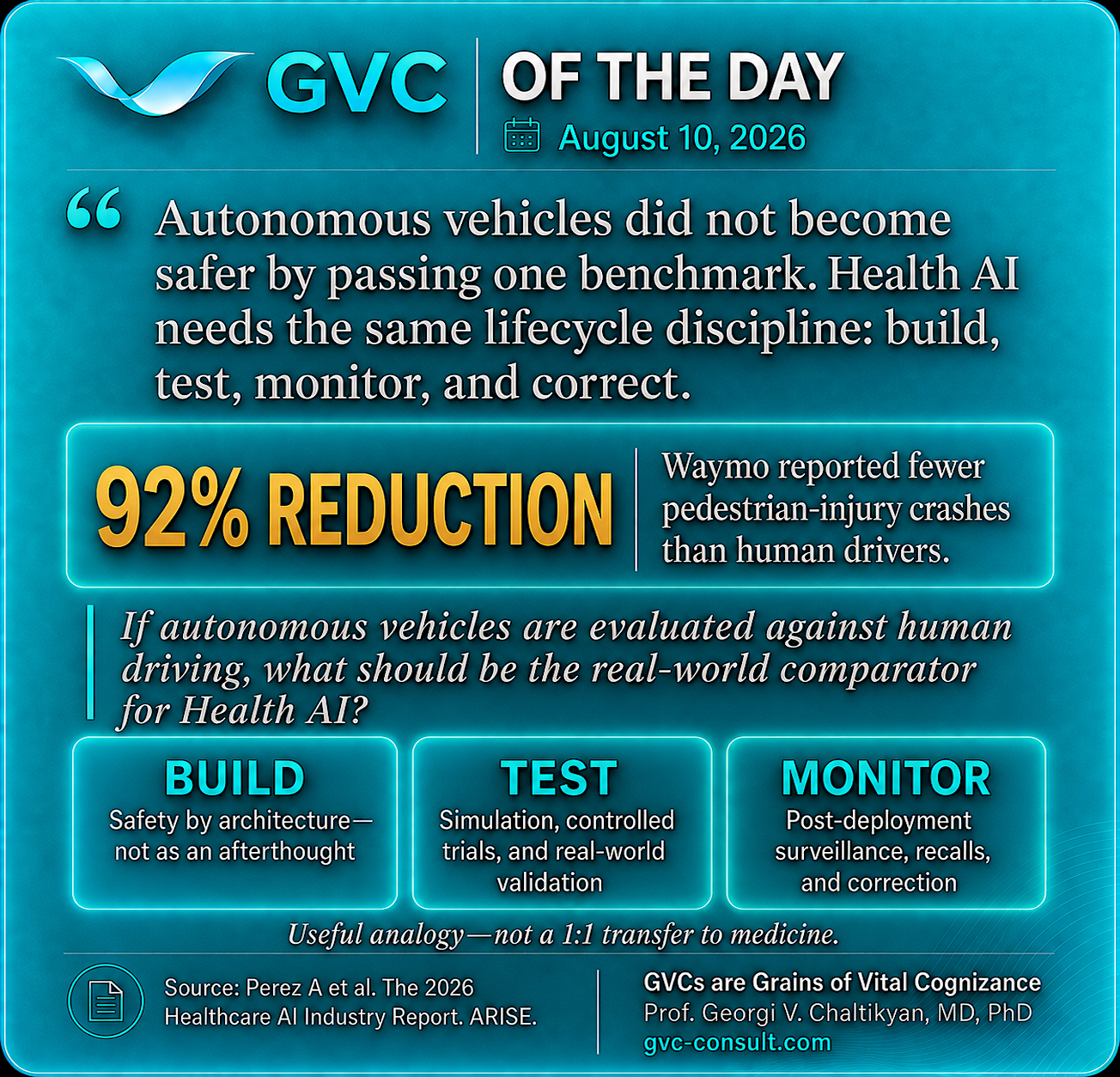
As an instructive example, the authors examine Waymo’s autonomous-driving safety framework. It defines safety as the absence of unreasonable risk and applies that principle throughout the technology’s lifecycle: safety-by-design, simulation and closed-course testing, progressively larger real-world deployments, readiness assessments for defined operating conditions, and continuous post-deployment monitoring and correction.
The report cites a 92% reduction in pedestrian-injury crashes for Waymo compared with human drivers. It also notes several software recalls in 2026—illustrating that monitoring and correction, rather than perfection, constitute the operative safety standard.
The analogy is useful but not directly transferable. Driving usually begins with a predefined destination. Healthcare often involves determining what the goal itself should be through complex clinician–patient interaction.
My takeaway: Health AI needs its own lifecycle safety framework. Capability benchmarks alone are insufficient. Evaluation must encompass the complete deployed system, the human–AI team, real-world adverse events, omissions, escalation mechanisms and the harms that the technology both causes and prevents.
Judging Health AI against perfect healthcare is scientifically meaningless when real care includes missed diagnoses, delayed referrals and inconsistent advice. The relevant comparison is measurable real-world care—while continually raising the standard for what counts as acceptably safe.
GVCs are Grains of Vital Cognizance, by Prof. Georgi V. Chaltikyan, MD, PhD.