
August 14, 2026 · Genomics, reproductive medicine and risk communication
The Genome Remembers Reproductive Timing
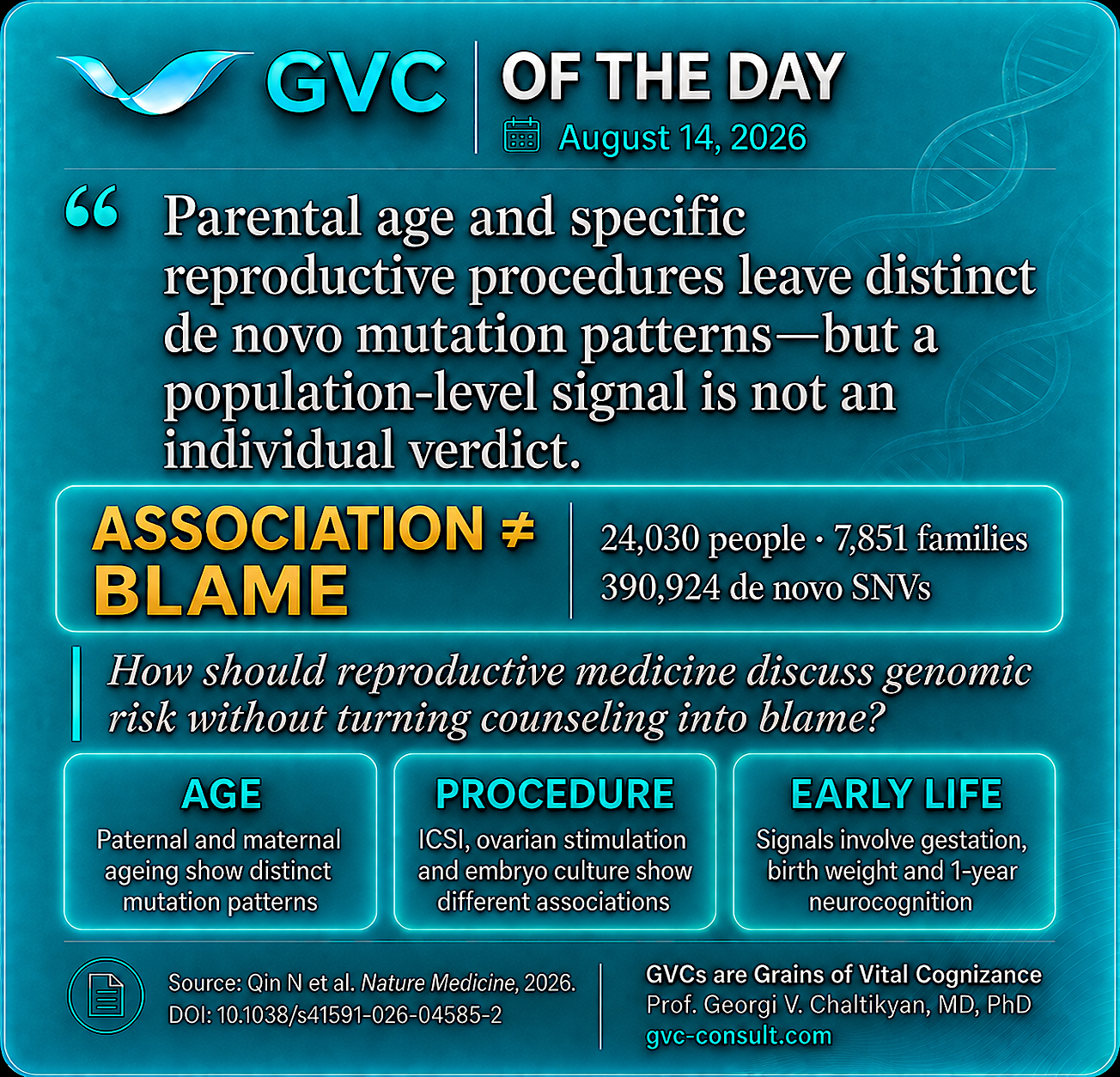
A major Nature Medicine study analysed whole-genome sequences from 24,030 people in 7,851 families, identifying 390,924 de novo single-nucleotide variants.
The researchers found distinct patterns associated with parental age. Each additional paternal year was associated with 1.06 more paternal de novo mutations. Each maternal year was associated with 0.38 more maternal mutations, with accumulation accelerating at older ages.
Assisted reproductive technology was not one homogeneous exposure. ICSI was associated with increased paternal mutations, while GnRH-antagonist ovarian stimulation was associated with increased maternal mutations. Embryo freezing and extended culture showed different associations with early post-zygotic mosaic mutations.
Some genomic signals also reached early-life outcomes. Paternal mutations were associated with slightly shorter gestation and lower birth weight. Each additional C>A mosaic mutation was associated with a 14% higher risk of delayed neurocognitive development at one year.
Context is essential. Offspring carried an average standardized count of approximately 62 de novo mutations. ART-conceived singletons had an adjusted average increase of 2.48 mutations, and only 0.34% of identified de novo SNVs were functional coding variants. The overall burden of parent-origin mutations was not associated with birth defects or neurodevelopmental outcomes at one year.
My takeaway: genomic association must never become reproductive blame. These findings support procedure optimisation, longer follow-up, and transparent counseling—not claims that older parents or assisted reproduction caused harm to a particular child.
Risk communication should distinguish absolute from relative risk, individual procedures from generic “ART risk,” and association from causation. It should also make long-term uncertainty and individual context explicit.
This was an observational study from one Chinese birth cohort, restricted to live births and early follow-up. Its findings provide population-level biological insight—not causal estimates or guidance for individual clinical decisions.
GVCs are Grains of Vital Cognizance, by Prof. Georgi V. Chaltikyan, MD, PhD.