
August 25, 2026 · AI-assisted writing, scientific authorship and research integrity
Has Biomedical Publishing Crossed the AI Point of No Return?
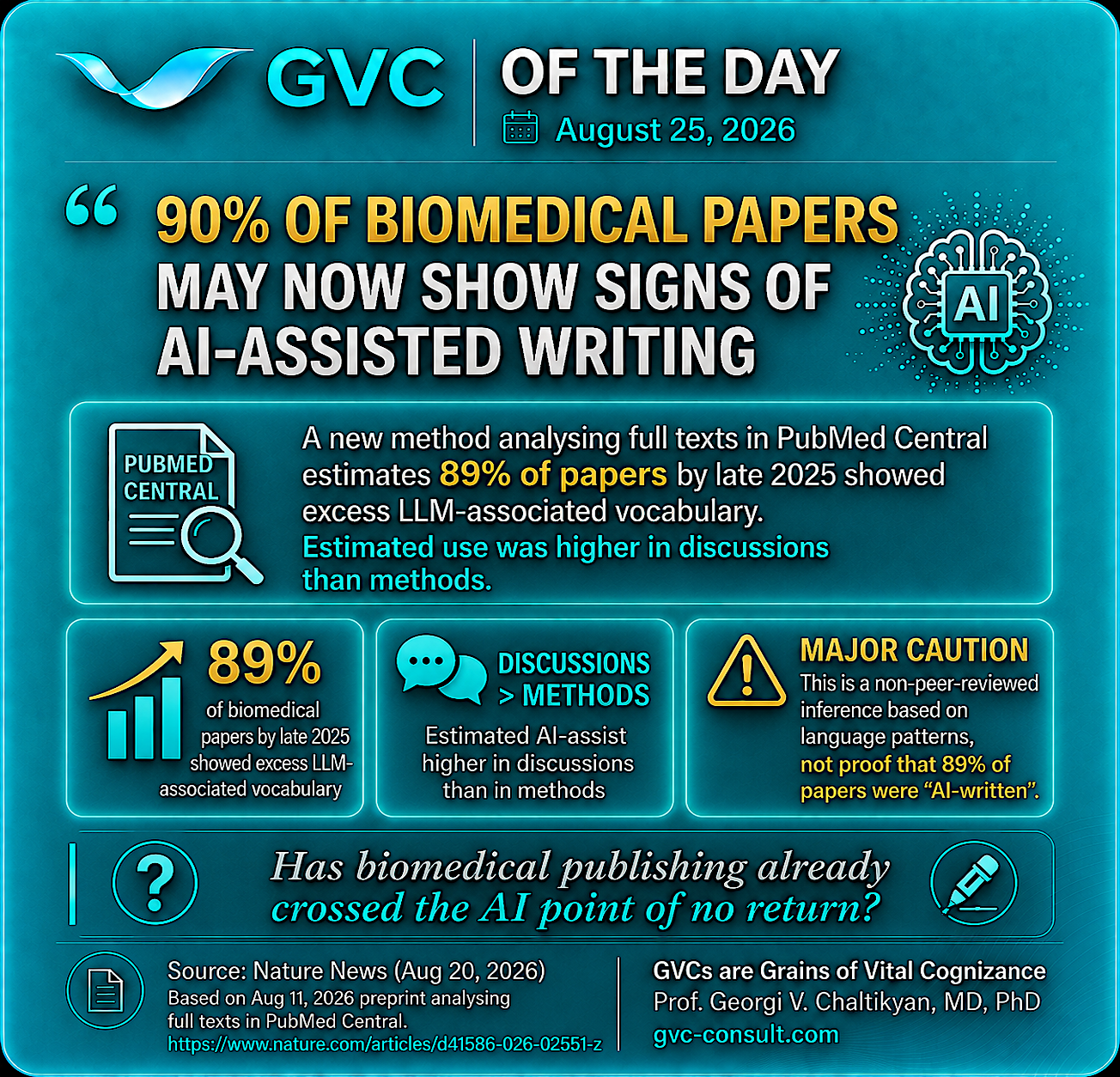
A preprint published on August 11 analysed full texts of open-access biomedical papers in PubMed Central using a new method based on changes in word frequencies associated with large language models. The authors estimate that by the end of 2025, 89% of papers showed an excess of LLM-associated vocabulary. They also estimate that LLMs were about twice as likely to have been used in writing a paragraph in the Discussion section as in the Methods section—68% versus 32%.
The result surprised even the researchers and is substantially higher than previous estimates. Nature highlighted the finding on August 20 under the headline “Staggering 90% of biomedical papers now show signs of AI help.”
The distinction between AI-assisted and AI-written, however, is essential. This is a non-peer-reviewed inference from population-level language patterns. The method cannot establish exactly how AI was used in an individual paper, how much of the text it influenced, or whether it contributed intellectually rather than merely editing or polishing language. The finding should therefore not be interpreted as evidence that nine out of ten biomedical papers were written by AI.
My takeaway: I would not be surprised if the proportion of scientific papers receiving some form of AI assistance eventually approaches 100%.
That would not necessarily represent a failure of scientific integrity. AI is rapidly becoming part of the ordinary research environment: supporting literature search, translation, coding, data analysis, drafting, editing, reference work and increasingly other parts of the scientific workflow.
At some point, asking “Was AI used in writing this paper?” may become almost as uninformative as asking whether the paper was written using a computer. The meaningful distinction will instead be how AI was used, for what purpose, and with what degree of human verification and responsibility.
This extends the problem raised in an earlier GVC on AI authorship and scientific credit. JAMA’s updated guidance keeps authorship and accountability human, while increasingly capable AI systems raise a different question: if an AI produces a substantive intellectual contribution rather than merely improving its presentation, does exclusive human attribution still accurately describe how the work was created?
The two issues point toward a broader change in scientific publishing. A simple declaration of AI used / AI not used may soon be inadequate. Scientific provenance may need to distinguish several different contributions: who generated the idea, who performed the analysis, who drafted or transformed the text, who verified the evidence, who accepts responsibility, and who deserves credit.
The challenge, then, is probably not to keep AI out of scientific writing. It is to ensure that increasingly AI-assisted science remains transparent, reproducible, accountable and genuinely scientific.
GVCs are Grains of Vital Cognizance, by Prof. Georgi V. Chaltikyan, MD, PhD.