
August 28, 2026 · Epigenetic clocks, longevity trials and surrogate endpoints
Can We Test Longevity Interventions Without Waiting Decades?
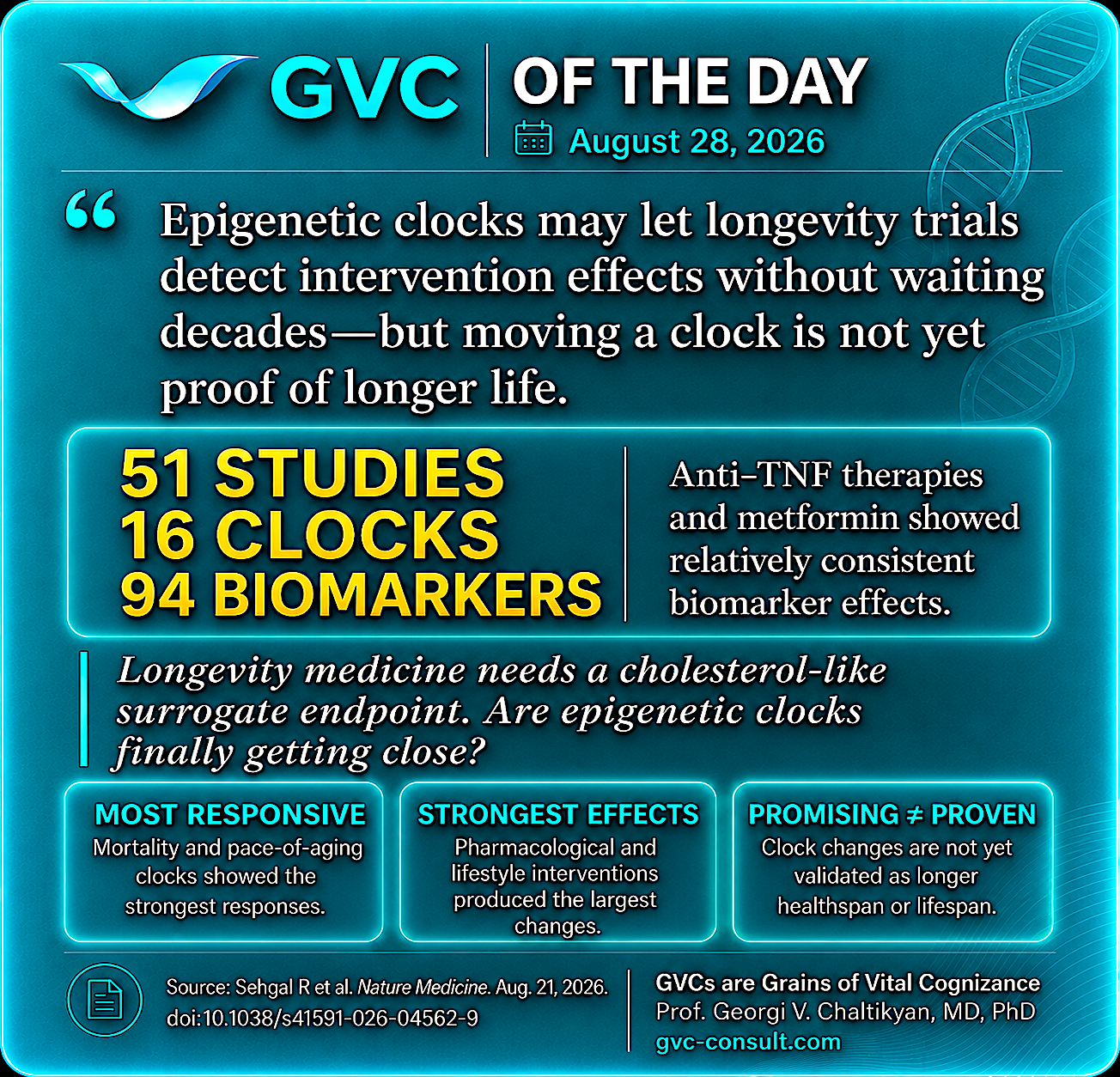
Researchers created TranslAGE, harmonising 51 longitudinal human intervention studies, 3,128 blood samples, 16 prominent epigenetic clocks and 94 additional DNA-methylation biomarkers.
Second-generation mortality and pace-of-ageing clocks showed the strongest and most consistent responses. DunedinPACE showed the largest average response, while PCGrimAge produced the greatest number of statistically significant findings.
Pharmacological interventions generated the largest average biomarker changes. Lifestyle interventions also significantly reduced epigenetic-age measures. Across repeatedly studied interventions, anti-TNF therapies and metformin produced comparatively consistent biomarker effects.
My takeaway: this could become extremely important for longevity science and 10P-Health. Validated surrogate biomarkers could make trials substantially faster, less expensive and more targeted—moving from waiting decades to count disease, disability and deaths toward measuring whether biological-ageing trajectories are changing.
But a younger epigenetic clock is not yet equivalent to a longer or healthier life. Responsiveness is a prerequisite for qualifying a surrogate endpoint—not evidence that qualification has already been achieved.
Prospective studies must demonstrate both that an intervention reliably changes the biomarker and that the change predicts meaningful reductions in morbidity, disability or mortality.
The analysis also pooled heterogeneous studies with different populations, interventions, durations and designs. It was intended to identify broad patterns of biomarker responsiveness—not establish the clinical efficacy of individual longevity interventions.
We may not yet have the longevity equivalent of cholesterol or HbA1c. But we may be getting closer.
GVCs are Grains of Vital Cognizance, by Prof. Georgi V. Chaltikyan, MD, PhD.