
September 1, 2026 · Biological computing, wetware and the future of computing
Living Neurons Have Entered the Server Rack
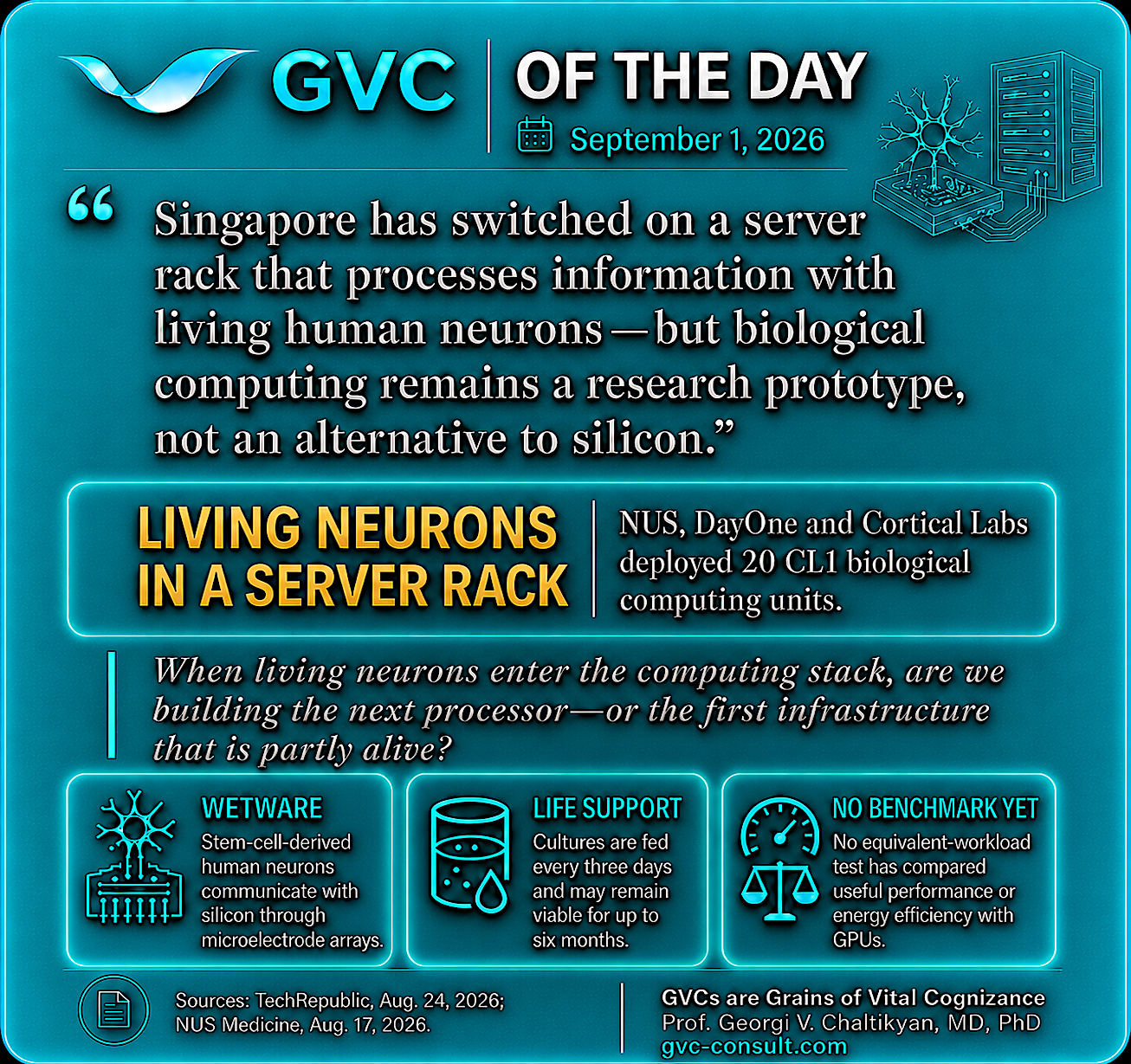
NUS Medicine, data-centre operator DayOne and Cortical Labs have deployed 20 CL1 biological-computing units at the National University of Singapore’s Life Sciences Institute. NUS describes the installation as the world’s first independently operated biologically integrated server rack.
Each CL1 combines stem-cell-derived human neurons with silicon hardware. The neurons grow across a microelectrode array that sends electrical signals into the culture and records its responses, allowing biological activity to interact with a software environment.
The biological component requires life support. The cultures are fed every three days, while the system regulates their temperature, gases and fluid environment. Cortical Labs says they may remain viable for up to six months.
My takeaway: the striking development is not that biology has replaced silicon. It has not. The real significance is that wetware has moved into a live, independently operated computing environment.
Potential applications being explored include drug discovery, neurological-disease research, biological modelling, robotics, cybersecurity and fraud detection. The energy argument is compelling in principle: biological brains perform extraordinarily complex tasks with remarkable efficiency, while conventional AI infrastructure is consuming increasing amounts of electricity.
But there is currently no equivalent-workload benchmark demonstrating that CL1 systems outperform GPUs or other processors in useful computing performance or energy efficiency. The NUS installation remains a research and validation platform—not an enterprise alternative to conventional AI hardware.
For now, the evidence supports four carefully separated conclusions: biological computing is real; living human neurons can interact with software through silicon interfaces; a 20-unit rack-scale research deployment is operating independently; and useful superiority over conventional computing has not been demonstrated.
The decisive tests will be whether these systems can perform reproducible, valuable workloads—and whether their biological variability, maintenance requirements, ethical implications and complete operating costs can be managed responsibly.
GVCs are Grains of Vital Cognizance, by Prof. Georgi V. Chaltikyan, MD, PhD.