
September 2, 2026 · Wearables, sleep tracking and trustworthy health inference
Measured Does Not Always Mean Inferred Correctly
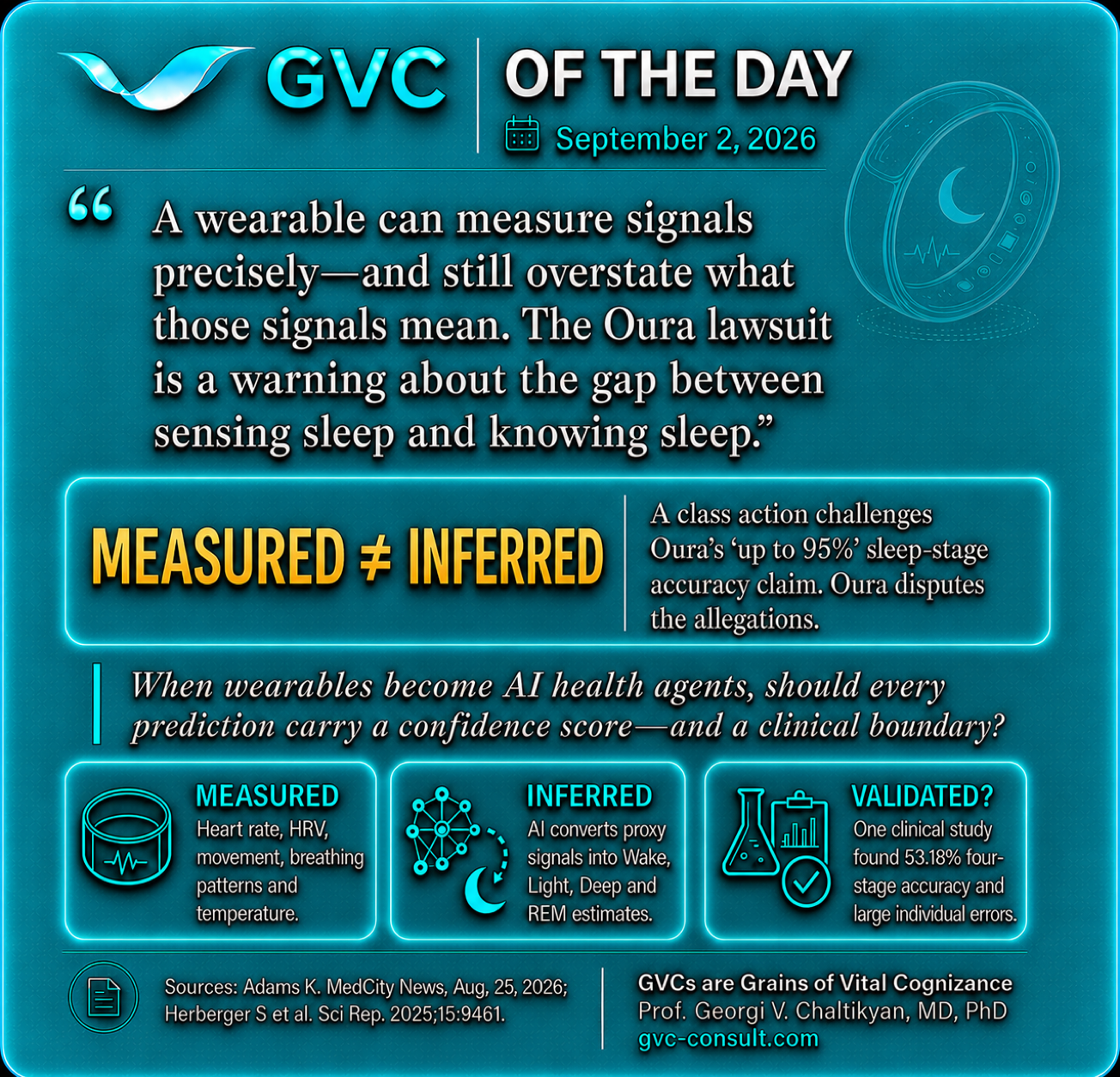
A proposed class action lawsuit disputes Oura’s claim of “up to 95%” sleep-stage accuracy. The complaint argues that the ring does not directly measure the brain activity and eye movements used in clinical sleep staging.
Instead, it estimates sleep stages from proxy signals such as heart rate, heart-rate variability, movement, breathing patterns and temperature.
The allegations remain unproven, and Oura disputes them. The company says its algorithms have been developed and validated against polysomnography and emphasizes that the ring is a consumer wellness product—not a medical device or substitute for a clinical sleep study.
The evidence needs context
A 2025 Scientific Reports study compared several wearable rings with polysomnography in a clinical sleep-laboratory cohort.
For four-stage classification—Wake, Light, Deep and REM—the Oura Gen 3 achieved 53.18% overall accuracy, with substantial errors for some individuals. Its simpler sleep-versus-wake accuracy was considerably higher.
The result should not automatically be generalized to every Oura device or current algorithm. It involved a single night, a clinical population and a particular device and algorithm generation. Oura has also argued that its technology has continued to evolve.
Nevertheless, the study illustrates a broader problem for consumer Digital Health:
- Measured: physiological signals captured by sensors;
- Inferred: an algorithm’s interpretation of those signals;
- Validated: evidence that the interpretation is sufficiently reliable for its intended use.
These are not interchangeable.
My takeaway
The significance of this case extends far beyond Oura.
Wearables are evolving from passive trackers into AI health agents that interpret physiology, identify patterns and increasingly influence health decisions. As that happens, trustworthy communication of uncertainty, confidence and clinical boundaries becomes as important as sensing accuracy.
A consumer may interpret “Your REM sleep was 18%” very differently from: “Based on indirect physiological signals, the algorithm estimates approximately 18% REM sleep, with limited certainty.”
Precision of presentation must not be mistaken for certainty of inference.
GVCs are Grains of Vital Cognizance, by Prof. Georgi V. Chaltikyan, MD, PhD.