
September 4, 2026 · Surgical AI, neurosurgery and real-time clinical decision support
AI Enters the Live Operative Field
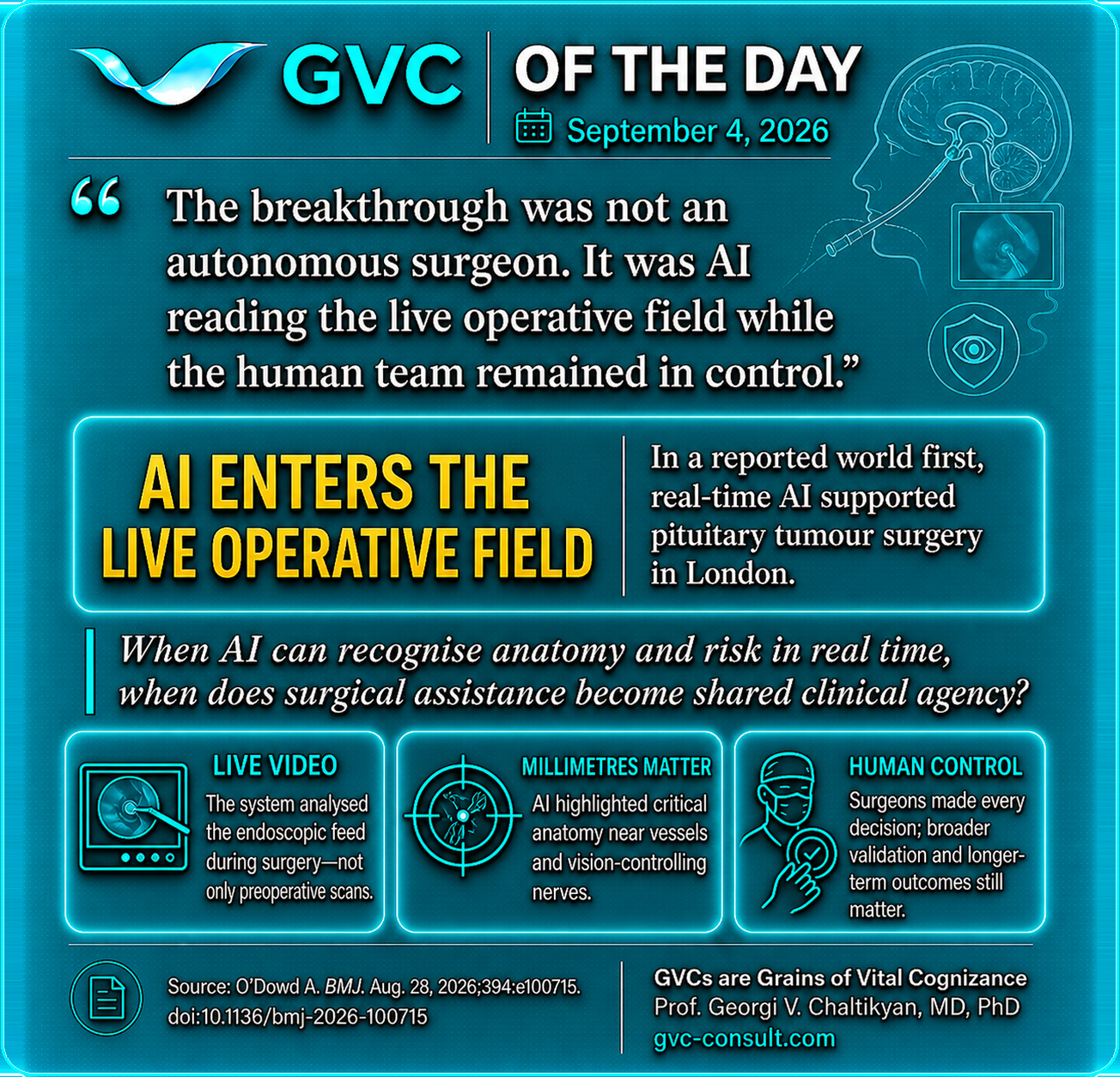
At London’s National Hospital for Neurology and Neurosurgery, a UCL-developed AI system supported surgeons in real time during the removal of a pituitary tumour.
The procedure is being described as the first use of AI to support a neurosurgeon during a live operation.
Unlike systems limited to preoperative scans, the AI analysed the live endoscopic video feed, helping identify critical structures at the base of the brain while surgery was underway.
In this exceptionally confined area, the pituitary gland, major blood vessels and nerves controlling vision lie only millimetres apart. The system highlighted risky anatomy to help the surgeons avoid critical structures while removing as much tumour as safely possible.
The patient’s tumour was successfully removed and his vision preserved. However, this individual outcome cannot establish that the AI itself improved safety or effectiveness.
From preoperative analysis to real-time perception
The system was trained and evaluated using a large collection of annotated videos from previous endoscopic pituitary operations. It was designed to recognise anatomy, surgical instruments and instrument–tissue interactions.
The important conceptual transition is:
Analysing data before surgery → interpreting the live operative field → supporting decisions while they can still change the outcome.
My takeaway
This is exactly the kind of surgical-AI development that deserves attention.
AI crossed an important boundary—from retrospective or preoperative analysis into real-time perception inside the operating room.
If validated, surgical AI could become a continuous perceptual and cognitive layer around the surgeon:
- Recognising critical anatomy;
- Highlighting danger;
- Supporting navigation;
- Tracking instruments and procedural context;
- Communicating confidence and uncertainty;
- Strengthening situational awareness.
But this was the first patient in an ongoing clinical trial—not comparative evidence that the system reduces complications or improves outcomes. The trial must still establish feasibility, safety, reliability and clinical benefit across more patients, surgeons and operative conditions.
Human surgeons made every clinical decision and remained fully in control. The current achievement is therefore augmentation, not autonomy.
Even so, the boundary between tool and teammate may become increasingly difficult to define when AI continuously perceives the operative field and contributes information at clinically decisive moments.
GVCs are Grains of Vital Cognizance, by Prof. Georgi V. Chaltikyan, MD, PhD.