
September 7, 2026 · Responsible AI, governance readiness and health-system capacity
Governance Defines AI Readiness
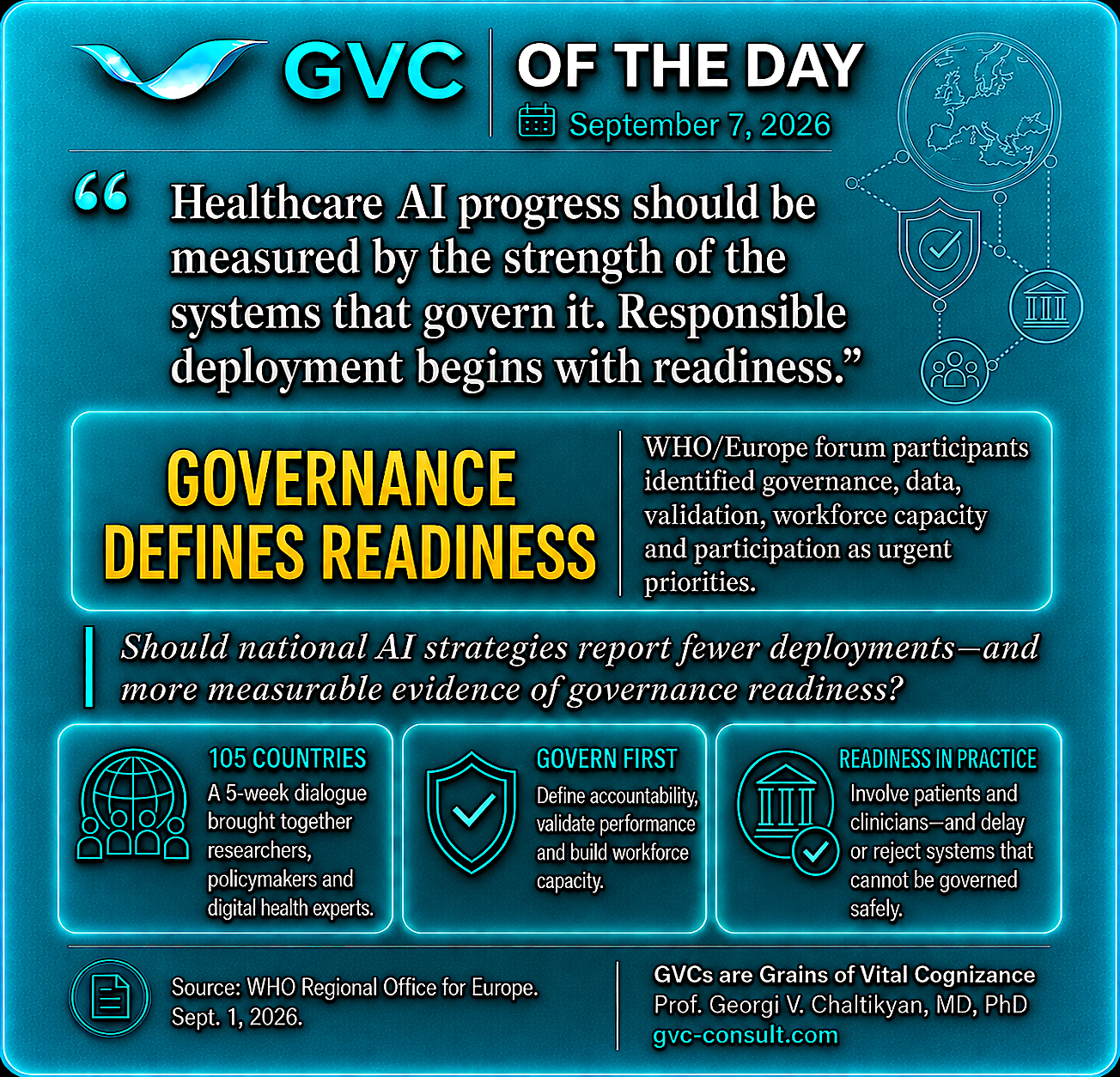
A new WHO/Europe report summarizes the organization’s first Knowledge Community on responsible artificial intelligence in health: a five-week structured online dialogue involving researchers, policymakers and Digital Health experts from 105 countries.
The central message is consequential: responsible progress in AI for health should be judged by governance readiness, rather than by deployment activity alone.
Participants identified familiar barriers:
- Fragmented and biased datasets
- Unclear accountability
- Gaps in AI literacy
- Weak or incomplete governance structures
- Insufficient involvement of patients, communities and frontline professionals
They also identified the foundations of responsible adoption: robust governance frameworks, codesign with patients and clinicians, transparency, equitable access to data and tools, proper validation and workforce capacity building.
My takeaway
Speed is easy to count. Readiness is harder—but far more important.
A health system is AI-ready when it can decide what should be deployed, validate performance in the intended context, define responsibility when harm occurs, monitor safety and effectiveness continuously, prepare the workforce, and involve patients and clinicians meaningfully.
Readiness also includes the institutional confidence to slow down, redesign or reject a system that cannot yet be governed safely.
This strongly resonates with our work at the WHO Collaborating Centre for Digital Health Education, Research & Development: technical capability is only one component of readiness. Workforce, institutional, governance and implementation capacity are equally decisive.
This is responsible innovation in practice—building the conditions under which useful AI can earn trust and improve health.
GVCs are Grains of Vital Cognizance, by Prof. Georgi V. Chaltikyan, MD, PhD.