
September 9, 2026 · Proteomic ageing clocks, geroscience and clinical trials
Longevity Clocks Enter Clinical Trials
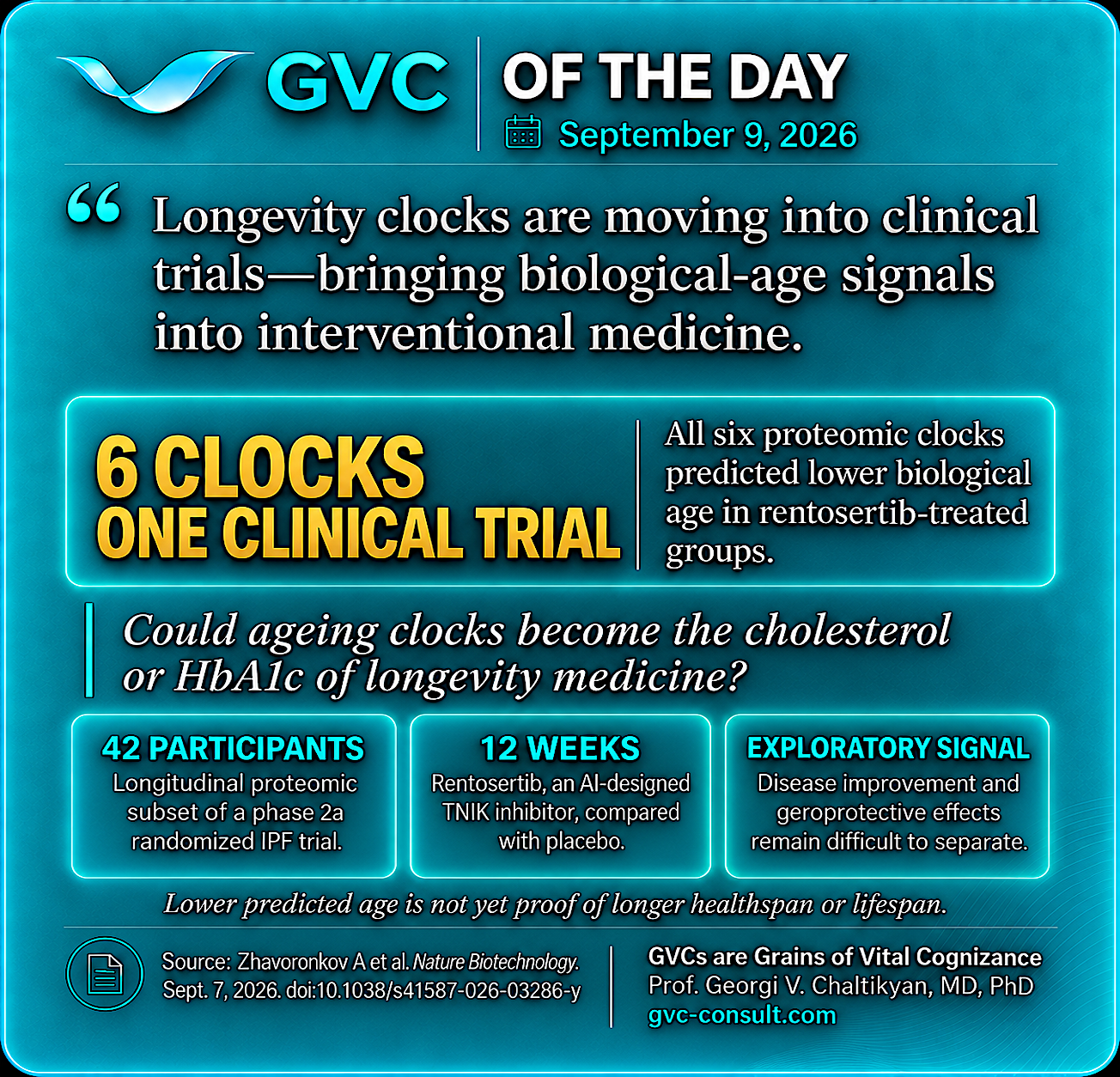
A new Nature Biotechnology study applied six proteomic ageing clocks to a phase 2a randomized, placebo-controlled trial of rentosertib, an AI-designed TNIK inhibitor being studied in idiopathic pulmonary fibrosis (IPF).
The analysis included 42 participants with longitudinal proteomic data from the 12-week trial. All six clocks predicted lower biological age in treated groups.
The significance is methodological: researchers can examine disease outcomes alongside exploratory signals of ageing biology within the same intervention study.
My takeaway
Longevity medicine needs practical ways to evaluate interventions without waiting decades for every answer. Ageing clocks become especially interesting when they help researchers ask two questions together: is a treatment improving the disease, and is it also shifting biological-age signals?
That could make future trials faster and more informative—provided the signals prove clinically meaningful.
These are exploratory measures, not validated surrogate endpoints for longevity. A lower predicted proteomic age does not establish longer healthspan or lifespan. In this setting, disease improvement and a broader geroprotective effect remain difficult to separate.
The next step is to establish what clock changes predict, how consistently they respond across interventions, and whether they add useful information beyond established clinical outcomes.
GVCs are Grains of Vital Cognizance, by Prof. Georgi V. Chaltikyan, MD, PhD.