
September 11, 2026 · AI genomics, variant interpretation and research infrastructure
Every Single-Letter Genome Change Is Now Searchable
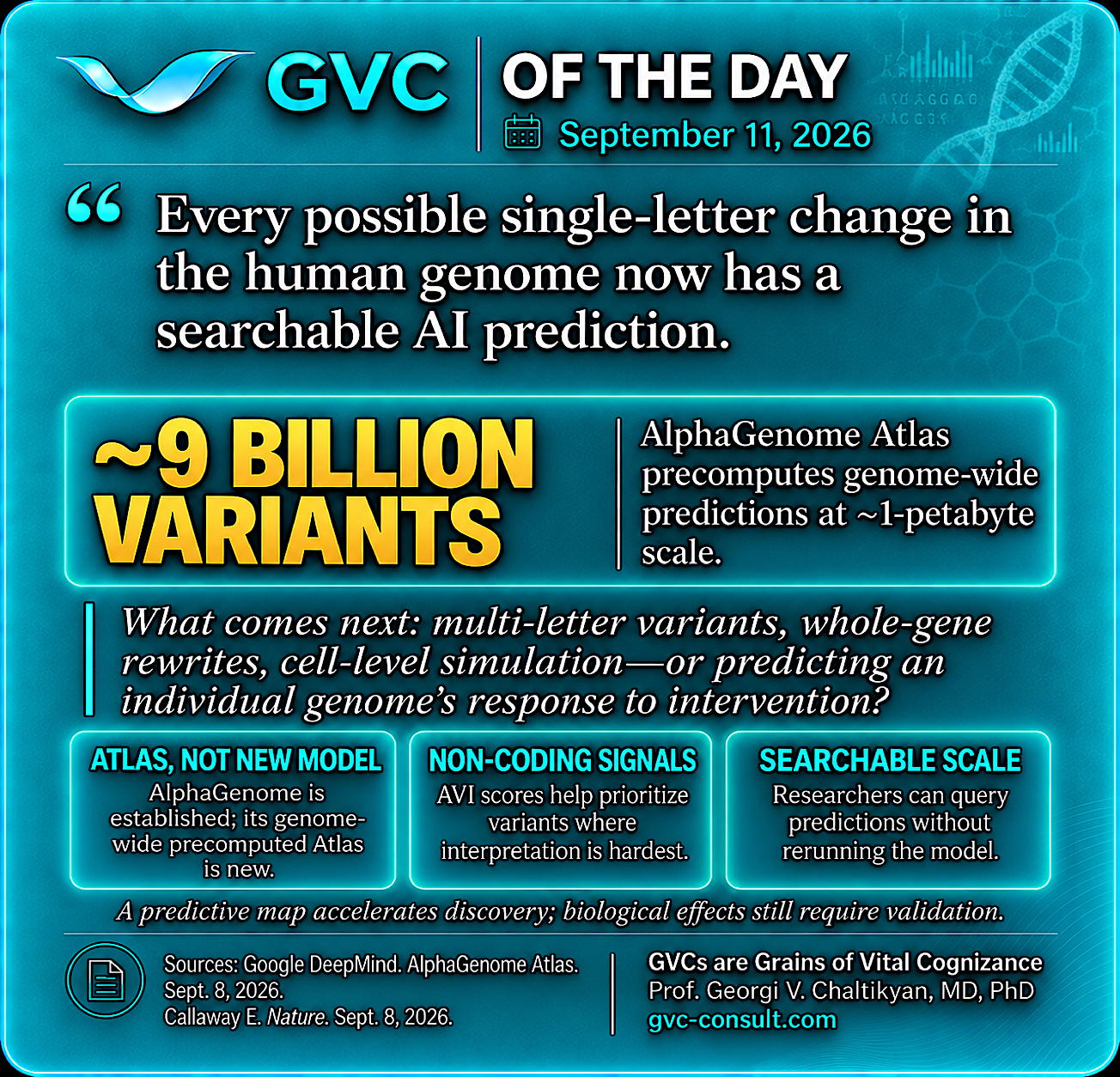
Google DeepMind has unveiled the AlphaGenome Atlas. The distinction matters: AlphaGenome is the existing AI model; the Atlas is the new, precomputed resource built from it.
The Atlas contains predictions for approximately nine billion single-nucleotide variants—the three possible substitutions at each of roughly three billion positions in the human genome. At about one petabyte, it makes these predictions available through a searchable portal and API for academic and non-commercial research.
This changes the practical workflow. Researchers no longer need to run the model separately for every mutation they wish to examine. Predictions have already been generated at genome-wide scale.
Why the non-coding genome matters
Only a small fraction of the genome directly encodes proteins. Much of the difficulty in clinical genomics lies in interpreting variants in non-coding regions that regulate when, where and how genes are used.
DeepMind has also introduced an AlphaGenome Variant Impact (AVI) score to help researchers rank variants by predicted molecular impact. Early examples include prioritizing a non-coding variant potentially linked to severe epilepsy and distinguishing disease-causing from benign variants in clinical-genomics data.
My takeaway
This is where a model begins to become infrastructure: build a powerful predictor, precompute at massive scale, make the resulting map searchable, and let researchers create new workflows on top of it.
For rare disease, cancer genomics and drug discovery, that reduction in computational friction could accelerate hypothesis generation and variant prioritization.
The boundary remains essential: nine billion predictions are not nine billion experimentally validated biological effects. The Atlas is a predictive map for discovery, and consequential findings still require clinical context and experimental validation.
Supporting source: Callaway E. DeepMind’s new genome ‘atlas’ charts effects of all 9 billion human gene mutations. Nature. September 8, 2026.
GVCs are Grains of Vital Cognizance, by Prof. Georgi V. Chaltikyan, MD, PhD.