
September 14, 2026 · Clinical agentic AI, cardiovascular care and FDA regulation
Autonomous Clinical AI Enters a Federally Funded Regulatory Pathway
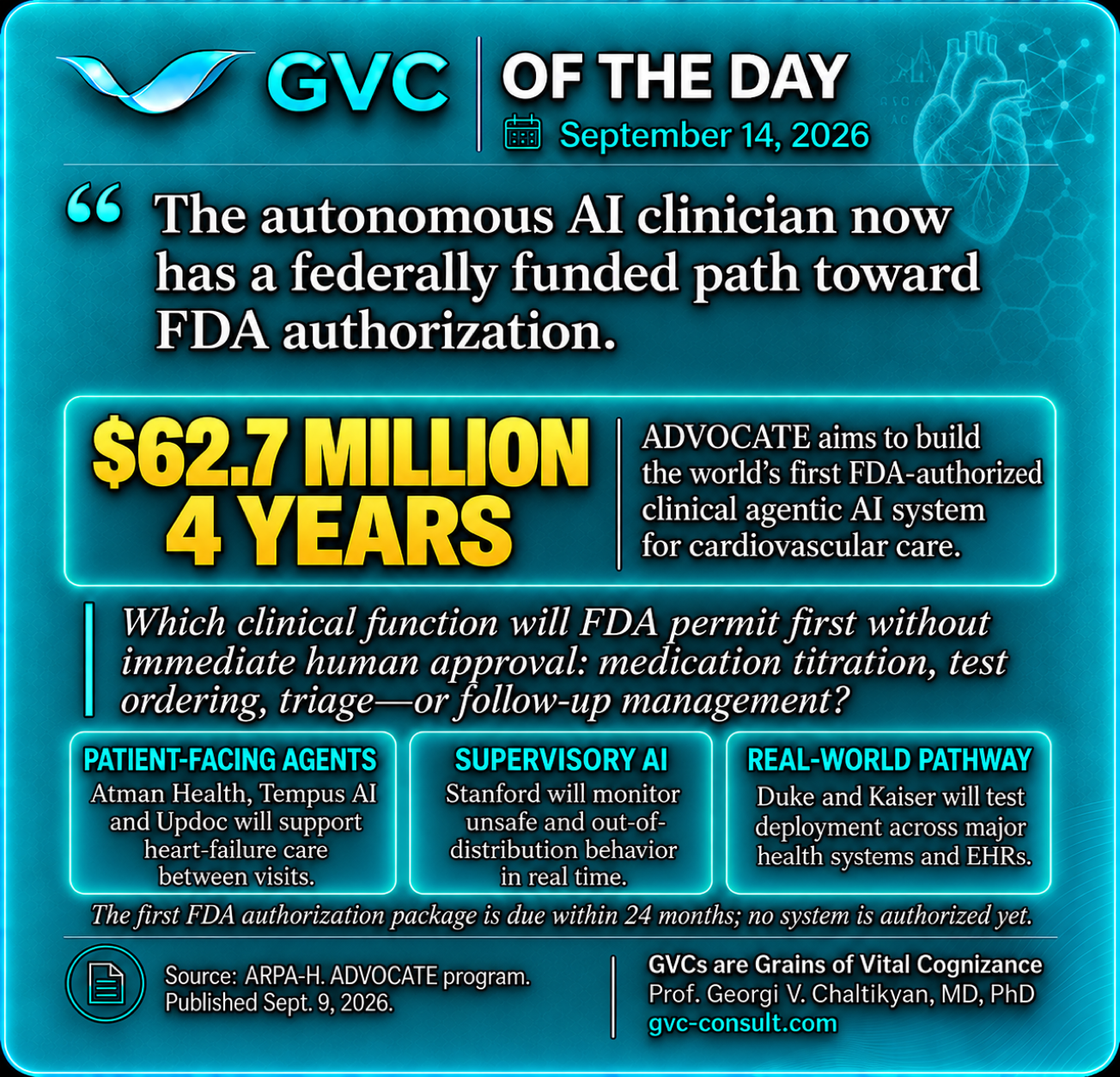
The U.S. Advanced Research Projects Agency for Health has launched ADVOCATE—a four-year, $62.7 million program aiming to create the world’s first reliable, FDA-authorized clinical agentic AI system for cardiovascular care.
The intended role goes beyond answering questions. Patient-facing agents are being developed to support people with heart failure continuously between visits, including symptom monitoring, medication management, appointment coordination, diet and exercise guidance, and escalation to human clinicians. Within defined boundaries, some care actions could be performed autonomously.
A layered safety and implementation architecture
Atman Health, Tempus AI and Updoc will develop patient-facing clinical agents. Their approaches include evidence-based decision engines, continuous multimodal monitoring, and separation of conversational intelligence from clinical authority through clinician-built rules.
Stanford University will develop a supervisory AI designed to detect unsafe recommendations and out-of-distribution behaviour in real time. Johns Hopkins University Applied Physics Laboratory will provide independent evaluation of technical performance and clinical outcomes.
Duke University and Kaiser Permanente will lead implementation and validation across major health systems. The planned environments include Epic and Oracle/Cerner EHRs, rural sites, shadow-mode deployments and pragmatic randomized clinical trials.
My takeaway
This changes the tone of the autonomous-clinician discussion. A federal health agency is now funding the technology, developing the safety architecture with selected teams, engaging FDA throughout the program lifecycle, and planning evaluation in real care environments.
The timetable makes this especially consequential: the patient-facing teams are expected to submit a first-of-its-kind FDA authorization package within 24 months of contract award.
Important limitation: no ADVOCATE system is FDA-authorized today. The program may still encounter technical, clinical or regulatory failure. What now exists is a funded pathway and a defined regulatory ambition—not an authorized autonomous clinician.
GVCs are Grains of Vital Cognizance, by Prof. Georgi V. Chaltikyan, MD, PhD.