
September 17, 2026 · Scientific AI, life sciences and enterprise R&D
Scientific AI Enters Real R&D Workflows
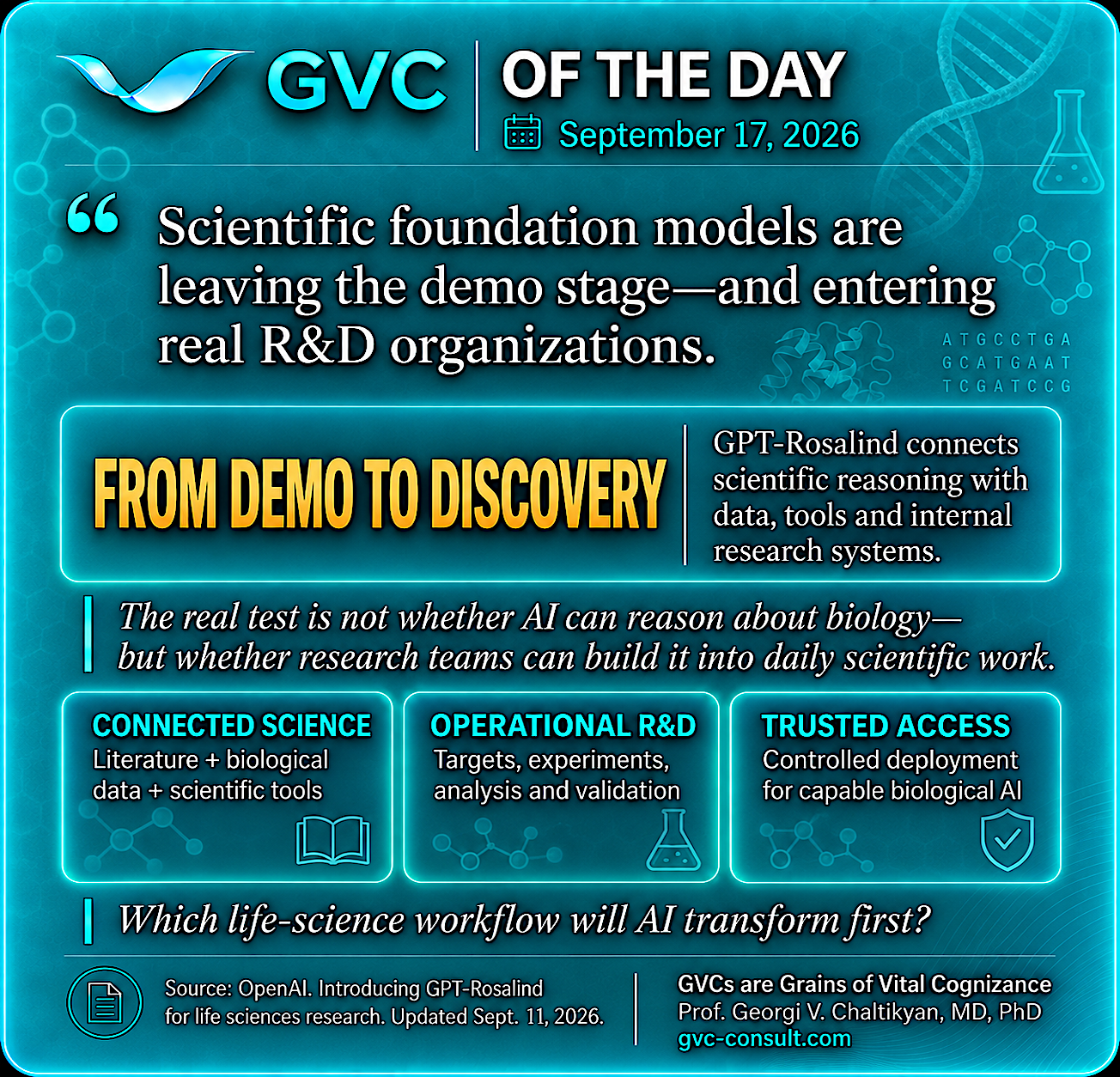
OpenAI’s GPT-Rosalind is moving beyond research preview and becoming available globally to eligible organizations through a trusted-access program. It is purpose-built for life-sciences workflows spanning genomics, sequencing, medicinal chemistry, drug discovery, protein analysis, evidence synthesis, experiment planning and scientific tool use.
The important capability is not biological reasoning in isolation. GPT-Rosalind can work across published literature, biological data, scientific tools and internal research systems—the heterogeneous environment in which real discovery decisions are made.
From benchmark performance to operational science
Real R&D is not a polished benchmark. It includes messy data, failed experiments, conflicting evidence, specialist tool chains, internal protocols, governance requirements and expensive decisions about what to test next.
OpenAI reports work with organizations including Amgen, Moderna, Thermo Fisher Scientific, the Allen Institute and Novo Nordisk. The emerging progression is clear: scientific reasoning, connected tools, operational workflows and enterprise R&D deployment.
My takeaway
If this transition succeeds, the impact will go far beyond faster literature review. Scientific AI could reshape how teams prioritize targets, design experiments, analyze data and move from hypothesis to validation.
Important limitation: access remains controlled. More capable biological models create genuine biosecurity and misuse concerns, while strong benchmark results do not by themselves prove reliable performance inside complex research organizations.
GVCs are Grains of Vital Cognizance, by Prof. Georgi V. Chaltikyan, MD, PhD.