
September 18, 2026 · Agentic AI, scientific publishing and reproducibility
From Static Paper to Executable Research Agent
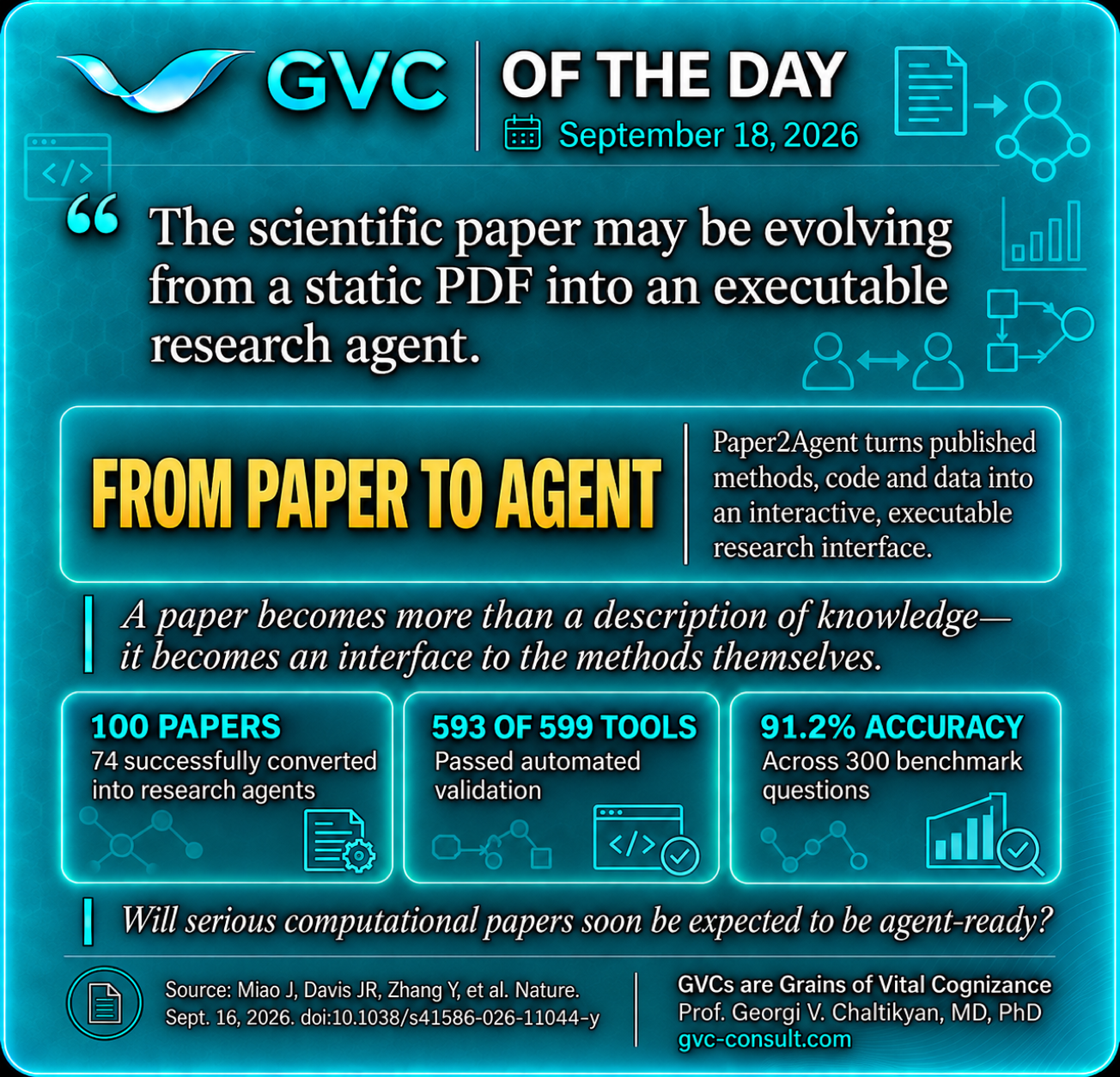
A new Nature paper introduces Paper2Agent, an automated framework that converts research papers into AI agents. This goes far beyond summarization: the agent exposes the manuscript, supplementary materials, datasets, code and workflows as active, reusable scientific resources.
A researcher can ask the agent to run an analysis, reproduce figures, apply the method to new data or work with agents derived from other papers. Paper2Agent builds a Model Context Protocol server containing executable tools, structured resources and workflow prompts, then tests the tools against reference outputs.
From describing a method to operating it
Among 100 computational-biology papers, 74 were successfully converted into agents. Of 599 proposed tools, 593 passed automated validation. On 300 tutorial-derived benchmark questions, the system achieved 91.2% accuracy while reducing cost and latency relative to giving an AI direct access to the paper and repository.
The authors also demonstrate paper agents collaborating to prioritize a candidate causal gene. That suggests publications could become modular components of larger AI co-scientist systems.
My takeaway
A research paper has traditionally been a description of knowledge. Paper2Agent moves it toward an interface to the knowledge and methods themselves. If this model matures, computational publications may increasingly be expected to be executable, interrogable and agent-ready.
Important limitation: not every paper can become a reliable agent. Missing code, unavailable data, broken dependencies, non-generalizable scripts and irreproducible workflows remain decisive barriers. Agentification can lower the friction of reuse, but it cannot manufacture reproducibility where the underlying research artefacts do not support it.
GVCs are Grains of Vital Cognizance, by Prof. Georgi V. Chaltikyan, MD, PhD.