
September 21, 2026 · Clinical AI, selective autonomy and patient safety
Clinical AI Learns When to Act—and When to Defer
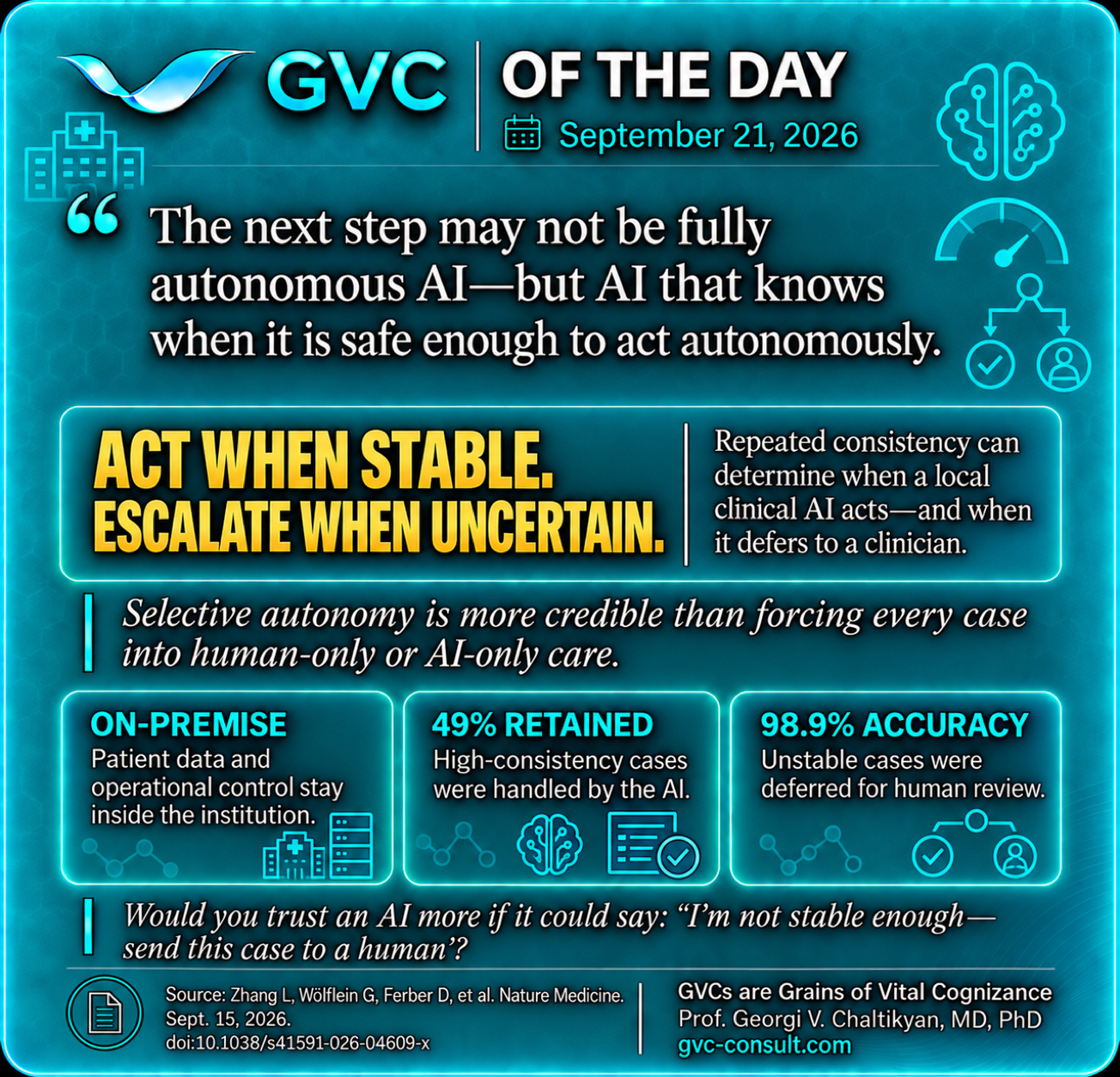
A new Nature Medicine study combines two capabilities clinical AI urgently needs: on-premise deployment, which keeps patient data and operational control within the institution, and decision-time reliability, which estimates whether an answer is stable enough to trust.
On two diagnostic benchmarks derived from MIMIC-IV, the best local model achieved 90.0% accuracy on a seven-disease task and 83.8% on a four-disease task. The more consequential result emerged when the same case was sampled repeatedly and consistency was used as an operational confidence signal.
Selective autonomy
At a high-consistency threshold, approximately 49% of cases were retained for automated handling and accuracy increased to 98.9%. The remaining cases were deferred for human review. This creates a practical middle ground between human-only and AI-only care: autonomy under defined conditions, with explicit escalation when reliability is insufficient.
My takeaway
Hospitals may be more willing to grant meaningful autonomy to systems they can govern, audit, version-control and operate inside their own infrastructure. An AI that can recognize instability and defer may be safer—and more useful—than one forced to answer every case.
Important limitation: these were retrospective simulations rather than prospective patient care. Consistency is not a universal guarantee of correctness, and thresholds will require clinical validation, bias testing, workflow design and continuous monitoring in every intended setting.
GVCs are Grains of Vital Cognizance, by Prof. Georgi V. Chaltikyan, MD, PhD.