
September 22, 2026 · Responsible AI, global health and implementation readiness
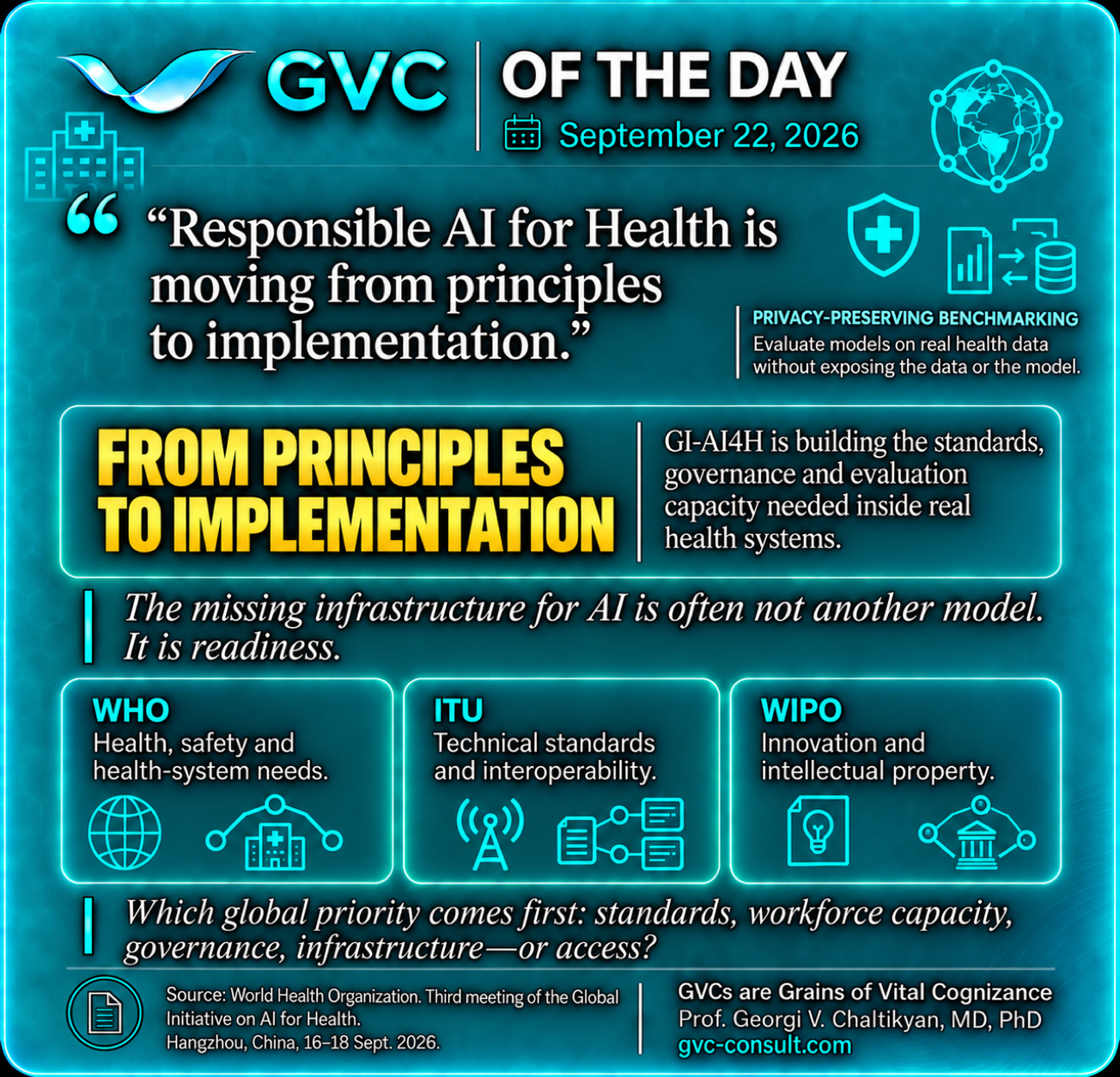
Responsible AI for Health Moves from Principles to Implementation
The third global meeting of the WHO–ITU–WIPO Global Initiative on AI for Health (GI-AI4H) brought policymakers, regulators, health professionals, researchers, technical experts, civil society and industry to Hangzhou, China.
The emphasis was practical: cross-border cooperation, standards and evaluation, real-world AI-for-Health use cases, capacity-building and the needs of countries at very different levels of AI readiness.
Benchmarking without surrendering data
The GI-AI4H Benchmarking Challenge tests privacy-preserving evaluation approaches that allow clinical data to remain under the control of the institutions holding it while submitted models are evaluated securely. Models are tested in their existing form rather than trained during the challenge, with solutions assessed for correctness, non-disclosure and cost.
This is the kind of shared infrastructure international deployment requires: credible model evaluation against real health data without forcing institutions to expose sensitive datasets or developers to disclose their models.
My takeaway
GI-AI4H brings together capabilities that too often live in separate rooms: WHO’s focus on health, safety and health-system needs; ITU’s technical standards and interoperability expertise; and WIPO’s remit around innovation and intellectual property.
The missing infrastructure for AI is often not another model. It is readiness: governance frameworks, standards, trained workforces, evaluation capacity and institutions able to decide what should—and should not—be implemented.
GVCs are Grains of Vital Cognizance, by Prof. Georgi V. Chaltikyan, MD, PhD.