
October 15, 2026 · Medical education, clinical reasoning and AI
Training Doctors for the AI Era
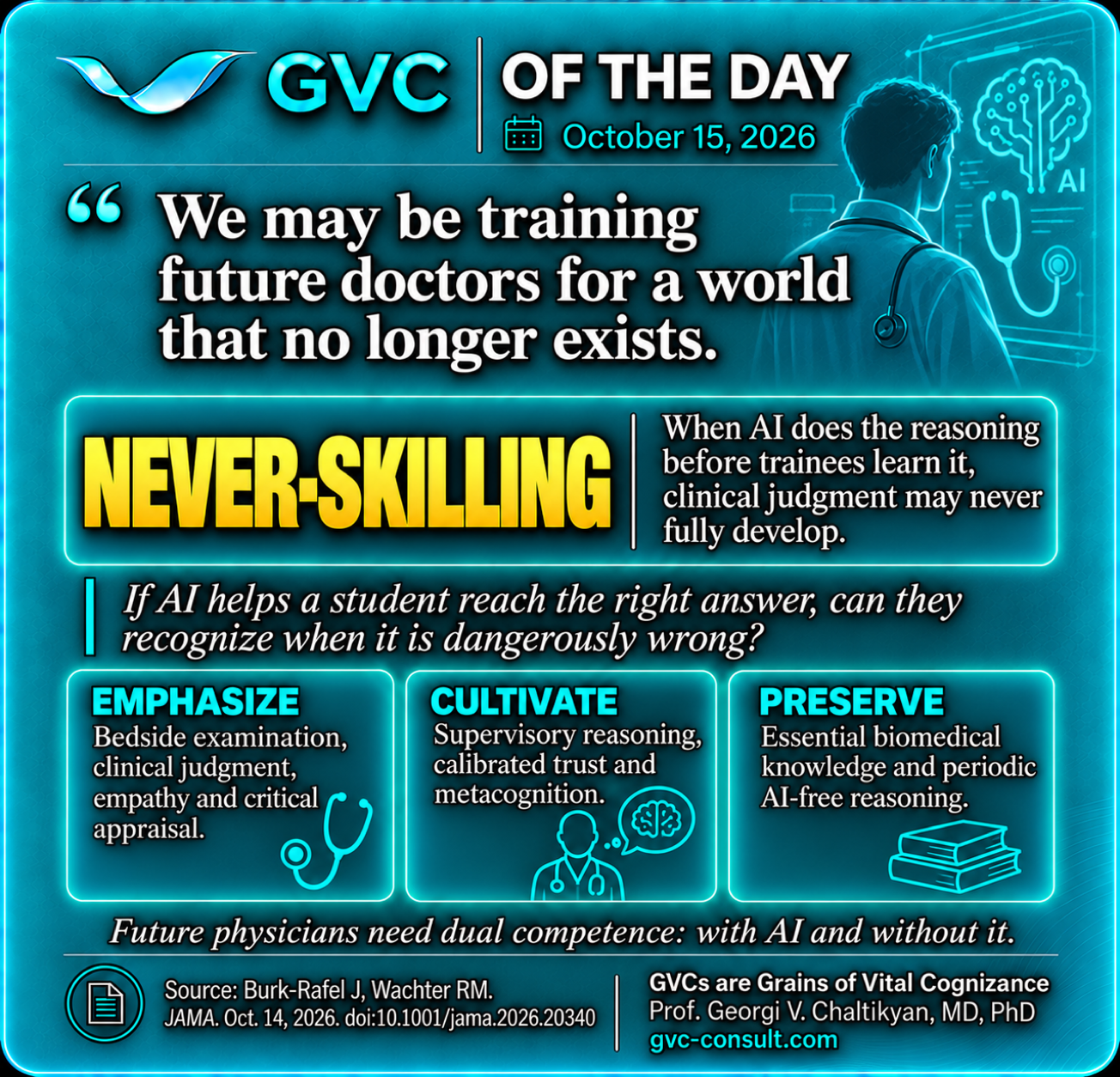
In a new JAMA Viewpoint, Jesse Burk-Rafel and Robert Wachter warn of “never-skilling”: future physicians may not develop some reasoning abilities if AI supplies answers before they learn to work through cases themselves.
They propose educational triage. Training should put greater weight on bedside observation, clinical judgment, patient relationships and critical appraisal of AI recommendations. It should also cultivate new capabilities: supervisory reasoning, calibrated trust and awareness of one’s own limits. Encyclopedic memorization can receive less emphasis where information can be reliably retrieved, without sacrificing essential biomedical knowledge.
My takeaway
Adding a standalone “AI in Medicine” course will not be enough. Medical education needs dual competence: physicians who can work effectively with AI and still reason when it is absent, unavailable or wrong.
That suggests AI-integrated teaching alongside deliberately incorrect AI recommendations, periodic AI-free reasoning exercises and assessments that reveal what the student contributed—not just what the system produced. This is a curricular argument, not proof that any one training design has already solved the problem.
GVCs are Grains of Vital Cognizance, by Prof. Georgi V. Chaltikyan, MD, PhD.