
October 27, 2026 · AI in science, distributed agents and neuroscience
1,946 AI Scientists, One Biological Experiment
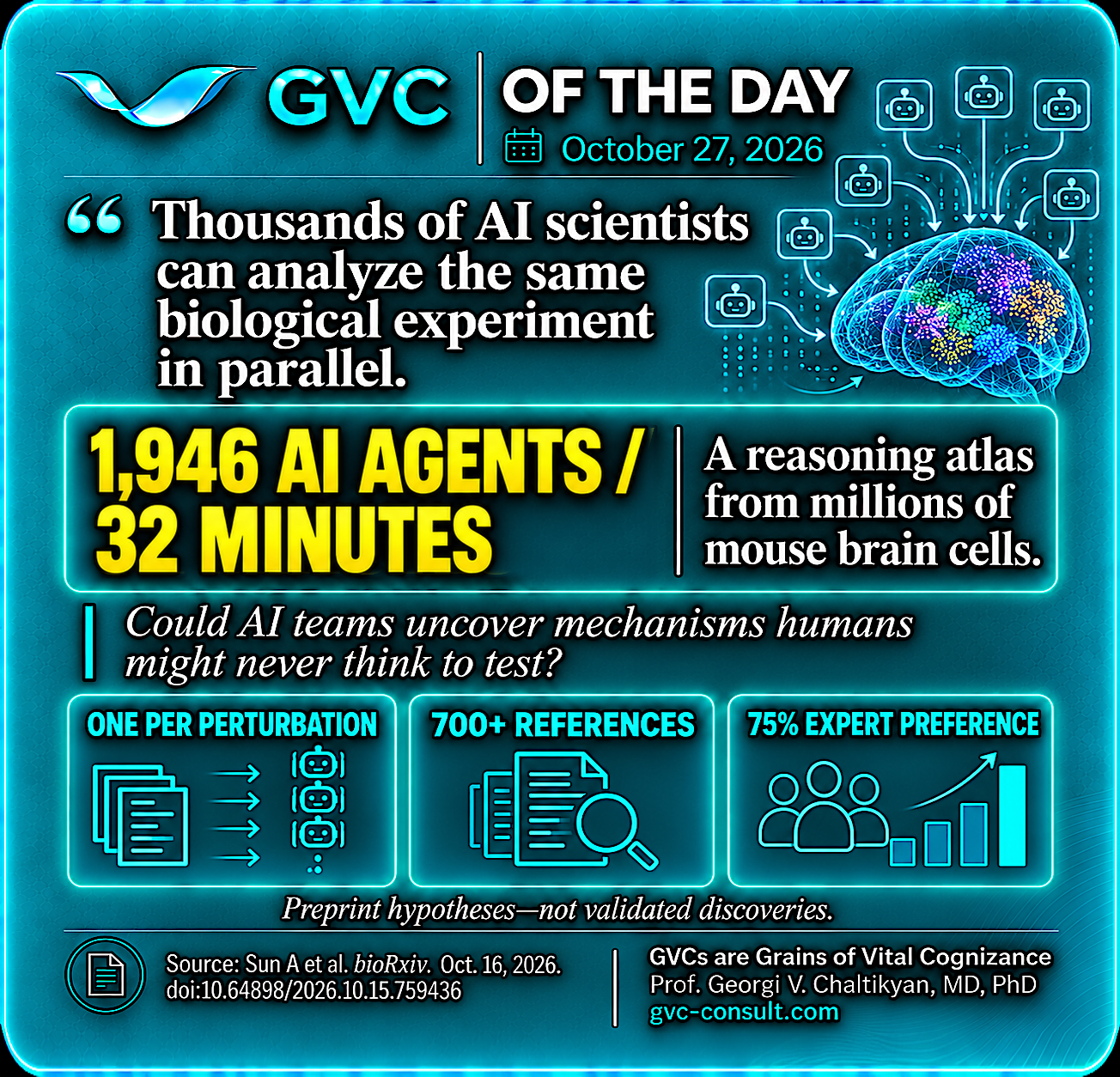
A modern perturbation experiment can change thousands of genes and measure responses across millions of cells. The data may contain more biological clues than a research team can inspect one result at a time. In this study, 1,946 AI agents analyzed a mouse-brain CRISPR atlas in 32 minutes. Each agent examined a gene disruption, cellular responses and relevant literature, then proposed explanations and follow-up questions.
The resulting reasoning atlas connects perturbations, cell-level effects, publications and possible mechanisms. It is not a collection of experimentally confirmed discoveries. Its value is in helping researchers decide which surprising signals deserve the next real-world experiment.
The distributed approach did more than divide the workload. At the largest comparison workload, the agents collectively retained more than 700 references, versus 11 for a single agent given the same broad task. In blinded comparisons, human experts preferred the distributed-agent reports 75% of the time.
My takeaway
This is a model of scientific teamwork at a new scale: a large experiment branches into many focused investigations, and their findings are recombined into a navigable map. The researchers highlight leads involving differences between Tsc1 and Tsc2 in particular brain cells, and a possible connection between Dctn1, cholesterol regulation and neurodegeneration.
None of those hypotheses establishes a new treatment or validated mechanism. The crucial next step is targeted laboratory testing. But the cycle could change how much knowledge researchers can extract from experiments they have already run: experiment → parallel AI analysis → prioritized hypotheses → human-led validation.
GVCs are Grains of Vital Cognizance, by Prof. Georgi V. Chaltikyan, MD, PhD.