
October 28, 2026 · Precision oncology, mRNA therapy and melanoma
Personalized mRNA Cancer Therapy: The Phase III Readout
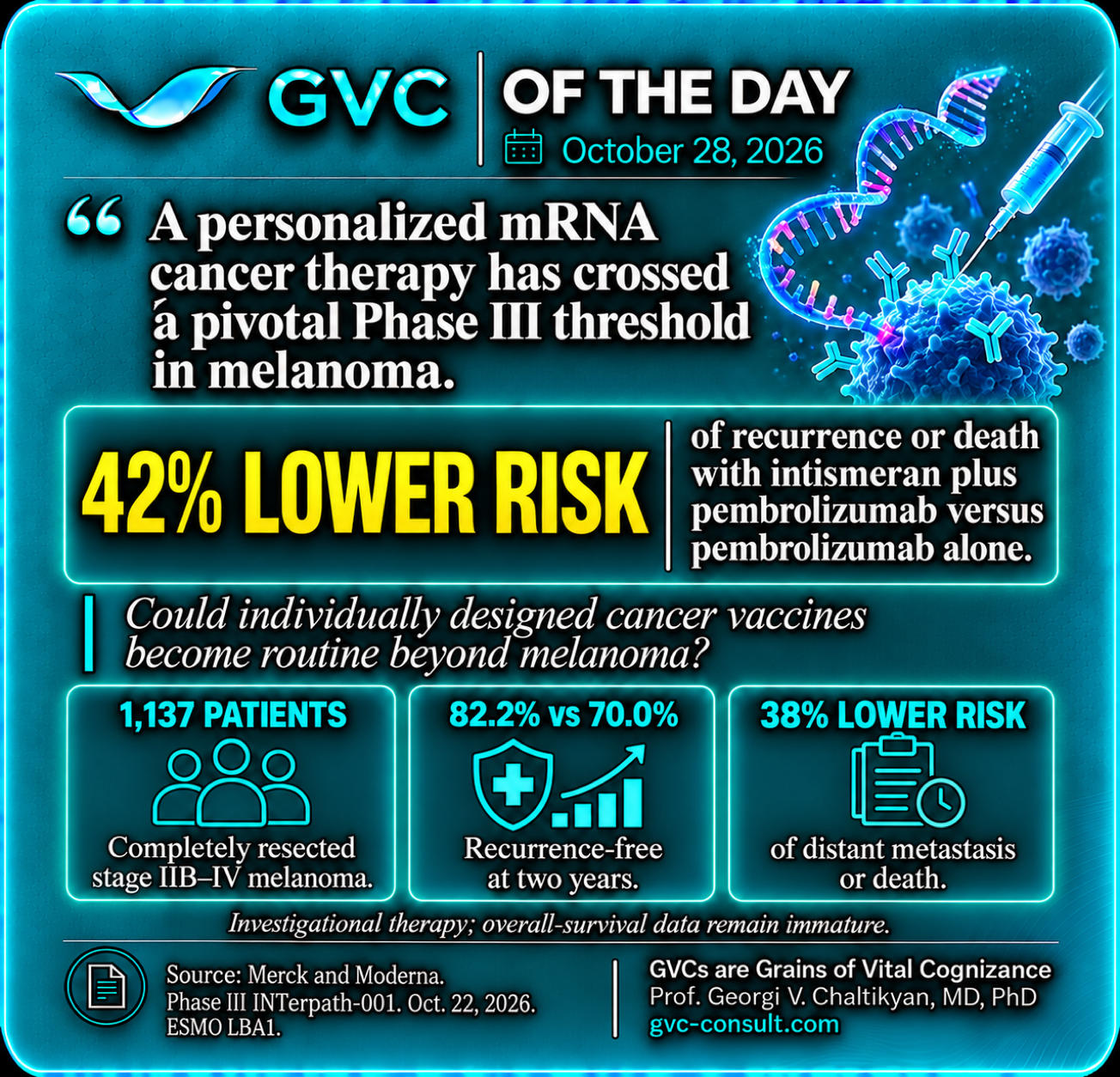
In August, we covered the first positive topline result for intismeran autogene, an individualized mRNA neoantigen therapy, combined with pembrolizumab after surgery for high-risk melanoma. The new development is the detailed Phase III readout from INTerpath-001, a randomized, double-blind study of 1,137 patients with completely resected stage IIB–IV melanoma.
At a median follow-up of 24.6 months, adding intismeran to pembrolizumab reduced the relative risk of recurrence or death by 42% compared with pembrolizumab alone (hazard ratio 0.58). It reduced the relative risk of distant metastasis or death by 38% (hazard ratio 0.62). The estimated two-year recurrence-free survival rates were 82.2% versus 70.0%—an absolute difference of 12.2 percentage points at that time point.
The approach makes the therapeutic product around a patient’s own tumor. Sequencing identifies candidate tumor-specific mutations; an individualized mRNA therapy encodes selected neoantigens to help the immune system recognize cancer cells. Pembrolizumab is given alongside it to release an immune checkpoint brake. This is a striking form of precision oncology: not merely matching an existing drug to a molecular subgroup, but manufacturing part of the treatment for one person.
My takeaway
That is why this result matters for Digital Precision Health and 10P-Health. The data strengthen the case that a digitally enabled pipeline—tumor sequencing, computational neoantigen selection, individualized manufacturing and immunotherapy—can produce a clinically meaningful signal in a pivotal trial. The central challenge now shifts toward showing durable benefit and making such a complex pathway reliable, timely and accessible outside a trial.
The limits are important. Overall-survival data are still immature, so these results do not yet establish that the treatment extends patients’ lives. The therapy has not been approved, and its benefit in other cancers is not proven. Long-term outcomes, safety, manufacturing turnaround, cost and equitable access all remain consequential questions. Merck and Moderna say they are engaging with regulators; that is a next step, not an authorization.
Still, detailed positive Phase III evidence is a substantial advance from the earlier announcement. The prospect of a cancer treatment built around each patient’s tumor is no longer confined to an early exploratory study.
GVCs are Grains of Vital Cognizance, by Prof. Georgi V. Chaltikyan, MD, PhD.