
October 30, 2026 · AI biology, phage therapy and antimicrobial resistance
AI-Designed Phages Reach a Patient
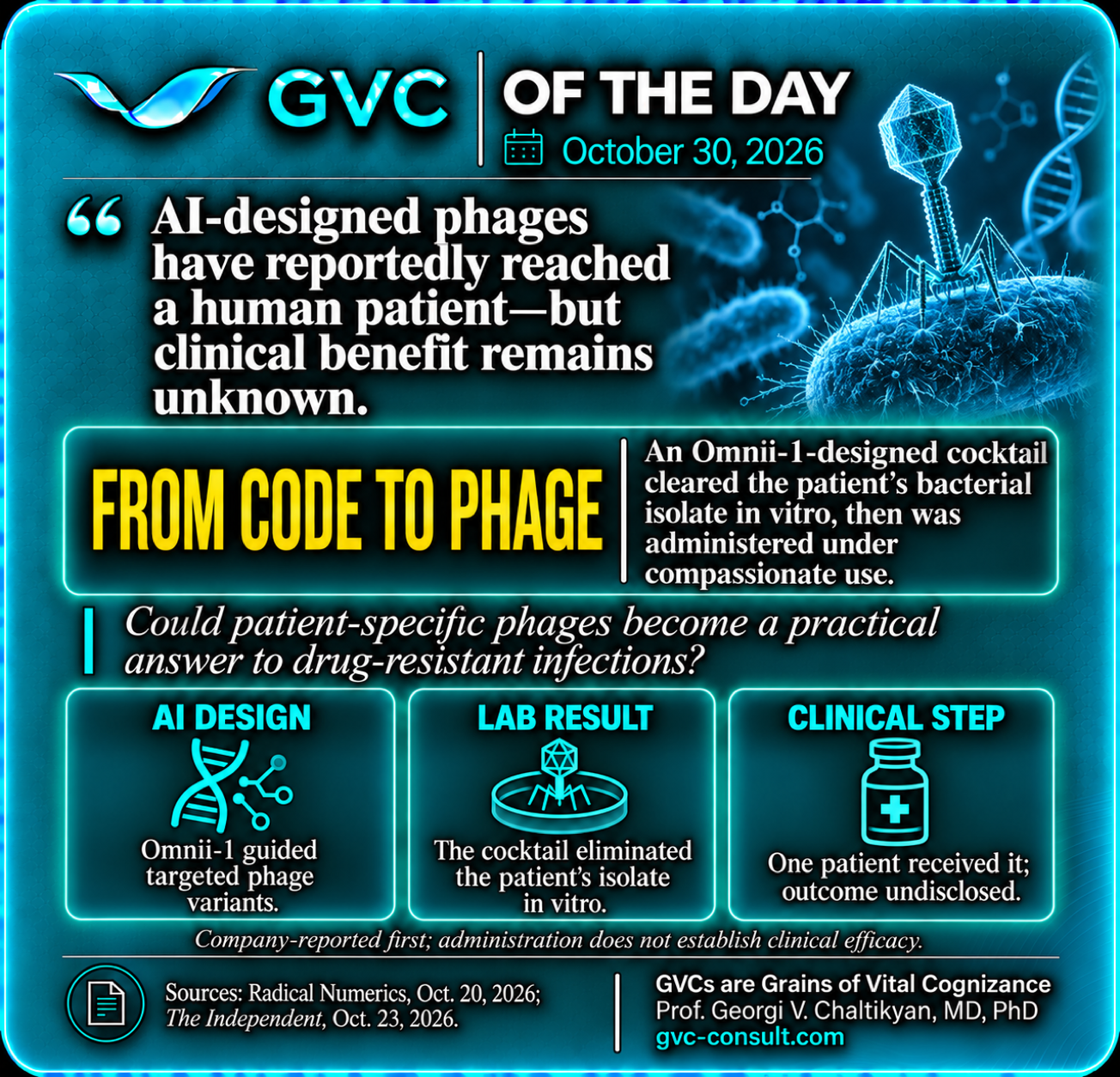
Bacteriophages are viruses that infect bacteria. Their specificity makes them intriguing candidates when a patient's infection resists conventional antibiotics, but it also makes finding a phage active against that particular bacterial strain difficult. California startup Radical Numerics says its biological foundation model, Omnii-1, helped design phage variants for such a case.
The reported sequence matters. The team identified the patient's resistant bacterial isolate, used the model to propose and prioritize phage designs, synthesized and tested candidates in the laboratory, and selected a cocktail. According to the company, that cocktail eliminated the patient's isolate in vitro. The investigational preparation was then administered under an authorized, physician-led compassionate-use pathway.
That is a meaningful move from computational design into a real clinical setting. It is also a carefully bounded claim. Clearing bacteria in a laboratory test does not show that the patient's infection cleared. Radical Numerics has withheld the person's clinical course and outcome to protect privacy. The reported “first” remains a company claim; independent peer-reviewed clinical validation is not yet available.
My takeaway
This is an early glimpse of what personalized antimicrobials designed on demand might look like: isolate a pathogen, design a biological agent against it, validate the agent experimentally, and consider treatment when other options are limited. The crucial step is the feedback between AI design and the laboratory. A model's prediction only becomes useful when a viable phage actually acts against the intended bacterial strain.
For AI-powered 10P-Health, this is the most compelling trajectory: tailoring an intervention to a person's biological problem rather than selecting only from a fixed catalogue. But personalized phage therapy would need far more than a capable model. Manufacturing, quality control, safety testing, regulatory pathways, rapid turnaround and careful monitoring all matter when the treatment itself may differ from patient to patient.
One compassionate-use administration cannot establish general safety or efficacy. The next evidence should document what happened to the patient, how the phages behaved in vivo, and whether this design-and-testing workflow can be repeated reliably across different infections.
GVCs are Grains of Vital Cognizance, by Prof. Georgi V. Chaltikyan, MD, PhD.